
Success story: From a Mid-Year Move to a Film About the Universe
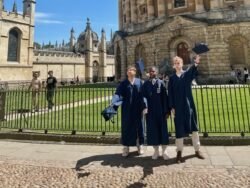
Vlad’s Year at Cherwell College
 He changed schools halfway through Year 13 and found the College himself, online. Within a term he was listening to Brian Cox — and making a film of his own.
The hardest point to start again
Most students who move schools do it between years. Vlad did it in the middle of Year 13, with public examinations already in sight — the point at which most sixth forms cannot take a student at all, because the timetable was set for a year group long ago.
He also did something unusual: he found the College himself.
“I transferred to Cherwell College in the middle of Year 13, after finding it myself online — not an easy point in the course to change schools, but it turned out to be the right decision.”
A tutorial college can accommodate a move like that because teaching is one-to-one and in small groups. There is no class to catch up with, and no scheme of work already three months in. There is a student, a subject, and a starting point.
A large sixth form builds a timetable around a year group. There is nowhere for a mid-year arrival to fit. A tutorial college builds one around a student.
Lessons shaped around what he needed
“Teaching here works on a one-to-one tutorial basis, alongside small classes, so lessons are shaped around exactly what you need.”
That sentence is the whole argument for the Oxbridge tutorial method, put more plainly than we usually manage. A tutor teaching one student can see precisely where the understanding thins out, and can spend the time on it that a class of thirty does not allow.
And then Oxford began
What Vlad did not expect was everything that arrived around the lessons.
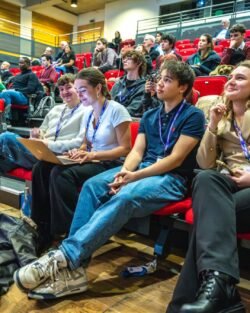
During Hilary term he took part in the ATOM Festival of Science and Technology, the Oxfordshire science festival chaired by our Principal — which is how our students come to find themselves in rooms that are usually beyond the reach of a school.
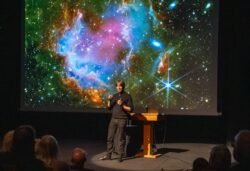
He heard Professor Brian Cox speak about the universe. He heard Professor Frank Close, the Oxford Physicist and one of the festival’s founders. And he came away with something rather more tangible than a memory:
“Beyond the teaching, the college offers opportunities you simply wouldn’t expect. During Hilary term I took part in the ATOM Science Festival, attended lectures by Brian Cox and Frank Close — and was even presented with one of Frank Close’s signed books, which was pretty cool.”
The point is not hearing a famous scientist speak. It is what happens to a student afterwards.
What happened afterwards
Brian Cox’s lecture did what a good lecture is supposed to do and rarely does: it did not end when the room emptied.
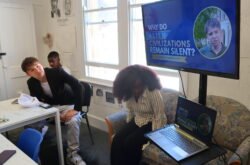
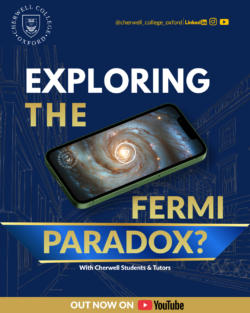
A group of our A-level students came away arguing about the Fermi paradox — the question of why a universe containing billions of stars far older than our Sun appears to be entirely silent. If intelligent life is probable, where is everybody?
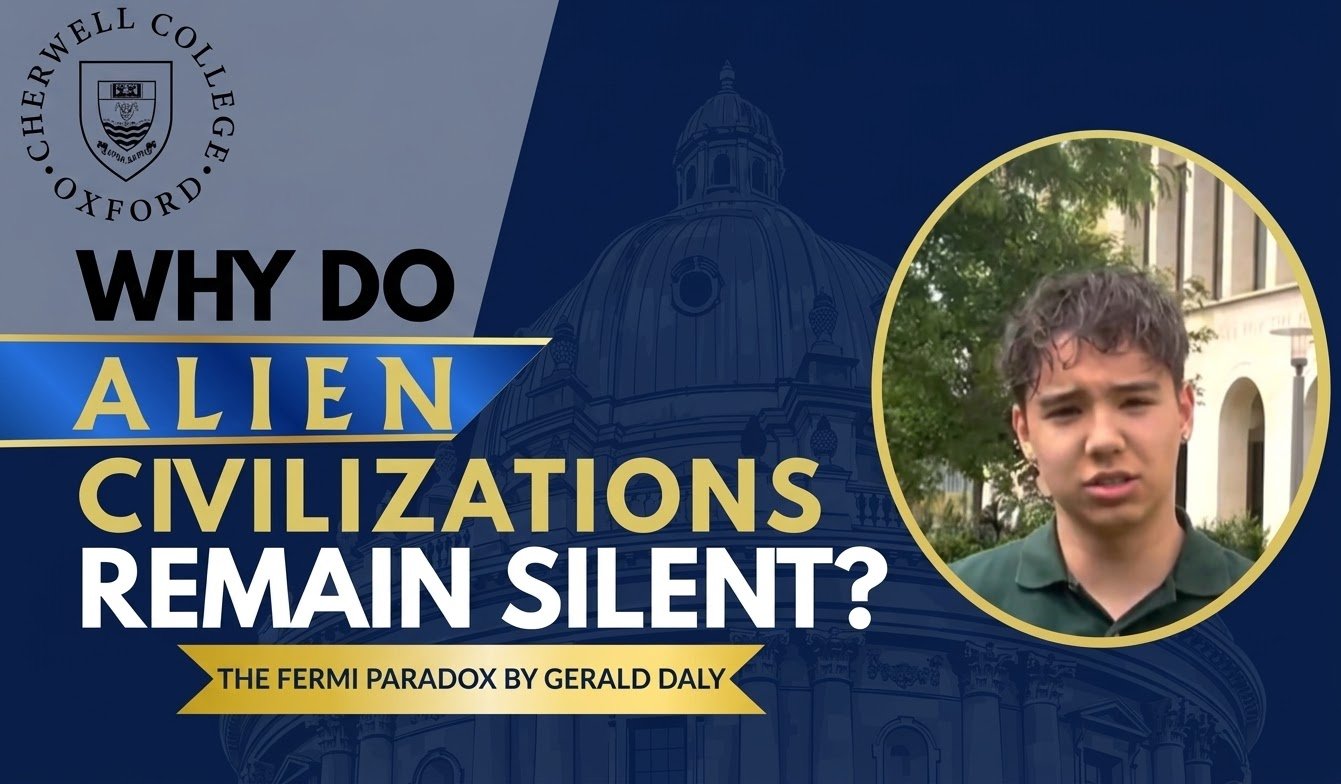
They read about it. They argued about it. And then they made a film about it — researched, scripted and edited entirely by themselves, drawing on physics, astronomy and philosophy at once.
Nobody set it as an assignment. Nobody marked it. That is the part that matters.
Watch the film on our YouTube channel
Enrichment is not measured by how many events a college puts on. It is measured by what students do afterwards, without being asked.
What a year can hold
Vlad arrived in the middle of Year 13 expecting to catch up and sit his examinations. He found teaching built around areas where he lacked knowledge, membership of the Oxford Union, a festival that brought world-class scientists within conversational distance, and a question about the universe that a group of teenagers decided to answer by creating a film.
That is what we mean by learning around the subject — and it is why we say that Oxford does a good deal of the teaching itself.
If you need to move mid-year
Because our teaching is individual rather than class-based, we can often take a student at points in the year when a conventional sixth form cannot. If your circumstances have changed — a school that no longer fits, a subject that is not offered, a year that has gone wrong — the practical question is simply whether the remaining time is enough.
The honest way to find out is a conversation. Our Vice-Principal explains the thinking behind this approach in this interview.
Explore our A-level programmes · Register your interest · Telephone +44 (0) 1865 242670