
Learning Around the Subject
How A-Level Teaching Works at Cherwell College Oxford

An A-level education should not stop at the edge of the specification. This is how we build an environment where curiosity grows — and why it produces better examination results as a by-product rather than as the only goal.
There is an idea often associated with Einstein: that the role of a teacher is not simply to teach, but to create the conditions in which a student can learn. It comes close to how we think about education at Cherwell College Oxford.
Academic excellence matters. Students need expert teaching, a strong command of their subjects and thorough preparation for their A-level examinations. But education becomes far more powerful when what happens around the subject is as stimulating as what happens within the syllabus.
We call this learning around the subject
Socratic teaching: from delivering answers to asking better questions

A lesson at Cherwell is not a lecture in which a teacher delivers information and a student writes it down. At the heart of our teaching is dialogue.
Through close academic discussion — usually one-to-one or in very small groups — students are encouraged to question what they are learning, test ideas and build their own arguments. This Socratic approach develops one of the most valuable abilities a student can carry beyond A-level: critical thinking.
Learning to ask a good question does not mean learning which questions a teacher wants to hear. It means developing the confidence not to be afraid of asking questions at all. Why does this happen? What evidence supports it? What if we look at the problem differently? And where does this idea lead if we follow it beyond the syllabus?
That last question is the important one.
Students can, in essence, take control of their own learning as active participants in learning through the tutorial system. And assessment informs learning plans, schemes of work not passive timetables, they change dynamically to fit exactly learners needs
What A-level enrichment actually means in practice
Every A-level has a specification, and an academically ambitious programme has a great deal of material to cover, but while a syllabus has boundaries, intellectual curiosity does not.
A Physics student needs to master the content required for the examination. Yet Physics is far larger than an examination specification. A conversation about the universe might lead to the Fermi paradox. That question leads to another, then to independent reading, discussion or research. Eventually a student is no longer learning because something is required for an examination. They are learning because they want to know.
Our job is to create the conditions in which that can happen — and Oxford is an extraordinary place in which to do it.
How Oxford becomes part of the classroom
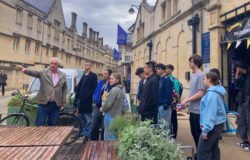
Being educated in Oxford means being surrounded by an intellectual community. We work to make that community accessible through talks, projects, festivals and encounters with people working at the forefront of their fields, further stimulated by membership of the Oxford Union for full-time students.
Students have had opportunities to encounter leading scientific thinkers including Professor Brian Cox and Professor Frank Close, through the ATOM Festival of Science & Technology, which our Principal chairs. The Innovation, Technology and Entrepreneurship Bootcamp we run with UC Berkeley’s Sutardja Centre at Keble College works on the same principle.
The significance of these experiences is not the prestige of hearing a famous scientist speak. It is what happens to a student afterwards. An idea encountered during a talk becomes a conversation with a tutor. The conversation becomes a question. The question leads to further reading, a project, independent research. One thing connects to another — and gradually a subject that existed within the boundaries of a specification becomes part of a much larger intellectual world.
A student’s experience: “I never expected this”
 Vlad’s experience captures what this environment can mean. He came to Cherwell with expectations that were primarily academic: one-to-one teaching, mastery of the material, intensive preparation for examinations.
What he did not expect was the intellectual world he would find around those lessons — that while still an A-level student he could encounter thinkers of the calibre of Brian Cox and Frank Close, or that distinguished academics could feel so accessible. That changed the scale of what studying Physics could mean.
The Fermi paradox is a good illustration. An idea met beyond the immediate demands of the syllabus generates new questions; those questions create the motivation to investigate. Students begin reading, researching and arguing because their curiosity has been activated rather than because it has been assigned. For Vlad, those encounters became a source of motivation to go further into his subject — and a group of our students went on to make a film about the paradox entirely of their own accord.
Learners needs are met and where possible, exceeded raising expectations the foundation of our learning culture
Why motivation cannot simply be taught
A college can teach knowledge. It can prepare a student for an examination, set assignments and measure progress. Genuine intellectual motivation is different. It develops when students begin to see that the subject they are studying is much bigger than the examination they are preparing to sit.
Close contact with teachers matters. Socratic dialogue matters. One-to-one academic attention matters. So does the wider environment — the conversations, encounters, projects and unexpected ideas that push a student to investigate something independently.
This is why we think of education as an ecosystem rather than a timetable. The teacher teaches the subject. The mentor helps the student develop. Oxford provides the intellectual landscape. The college connects those elements.
The teacher teaches the subject. The mentor develops the student. Oxford provides the landscape. The college connects them.
Beyond excellent examination results
 The purpose of learning around the subject is not to add more material to an already demanding programme. It is to widen a student’s intellectual horizon.
When students learn to question, when they meet people who expand their sense of what is possible, and when one idea leads naturally to another, something shifts. They become more intellectually independent. They research because they want to know. They grow more confident about entering conversations with people who know far more than they do. Their ambition for themselves grows.
One of our students, who arrived doubting he was any good at his subject, went on to gain the highest mark in the world in Cambridge International A Level History. The examination result was the outcome. The environment that produced it is the point.
We prepare students for their examinations. We build an environment designed to make them want to go further.
Find out more
Read our Vice-Principal on what a small college can do that a large school cannot, or explore our two-year A-level programme and university and Oxbridge preparation.
To discuss a place, register your interest or telephone +44 (0) 1865 242670.