
“We Work Like Jewellers”
Helen Clarke, Vice-Principal of Cherwell College Oxford, on how a small college turns potential into results: the precision work of teaching one student at a time, growing up away from the production line of large schools, and why a real education does not stop at the edge of a subject.
When parents are choosing a college — particularly an independent one, where the education is a serious investment — how should they judge its quality?
I think you have to look at the outcome. How successful the leavers are, how far they have got — what people call the success rate. You judge a college by the quality and the success of its leavers.
And then you see it: a student came to us from a very weak school, where they were bullied, where essentially neglected. And we took the student — and made a successful person.
That was painstaking work. Because it is not only about good teachers. I personally spent hours in conversation — not only with the student, but with the family, to settle the whole situation. And that is what success means.
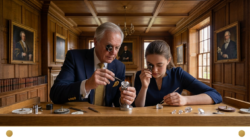
A small college is precision work. Parents investing that kind of money are not choosing an institution — they are choosing a small, personal college for their particular child. Do you see?
And here is something else worth understanding. For over more than fifty years, an education at Cherwell College Oxford has become a kind of hallmark. Admissions tutors have seen our leavers — they have seen how well prepared they are, how they write, how they hold themselves at interview. Our preparation is known. And that reputation works for every leaver who follows.
“A small college is precision work — a jeweller’s work. You are not running a production line; you are cutting each stone separately.”
So this is not only about academic results?
Of course not. It is also the ability to surround a student, to give them the wider education the British call learning around the subject. You build a whole plan of extra-curricular activities around the subject.
For example, in Sean’s current group — he teaches politics and history — one of the students is fascinated by the history of the British Admiralty. And to help him understand how the knowledge he is acquiring shaped today’s reality, how a maritime power actually operates now, we give him the chance to see it in practice.
So alongside the theory, he helps to prepare serious events — a forum on critical infrastructure, for instance. And there he applies what he knows about the British political system.
When I was preparing that forum — writing letters, sending invitations — I would consult him: “Tell me, who is the right person to approach in the House of Lords?” And he would answer: “What you probably need is a particular pressure group.” Or he would point out someone with a background in the Royal Air Force.
So he is no longer simply studying theory — he is watching how it all works in the real world today. And at the same time he is helping us to put together seminars and events.
That is a very important experience. Because one of the great problems in education today is that students arrive at university without really understanding how theory translates into practice.
But students come to you with very different aims, don’t they?
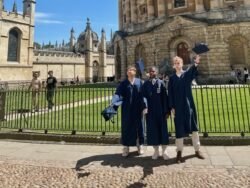
Yes, everything is individual. The first group are students better suited to the traditional route: two years of Sixth Form. That format allows a student to learn and to develop at a pace that is comfortable for them. There is time to grow into a subject — and to grow as a person.
The second format is Fast Track, which is our own distinctive product. It is an accelerated course: two years of A-level compressed into one. It suits academically mature students — those who already have serious grounding, who completed their schooling in their own country by the age of seventeen, or those who are deliberately changing direction and taking new subjects with a particular goal in mind. We always say honestly that Fast Track is not for the majority. Before offering a place we look carefully at academic background and at English, because it is a genuinely demanding course. But for a student who is ready, it is an enormous advantage.
Often these students have already had everything a top school can give them — and that is it, the top school has nothing further to offer. Why? Because it is a production line: large classes, and no possibility of that individual attention.
For example a male student has finished school and he realises that he is not yet ready to become, say, a pilot. And he wants to be a pilot. So he takes Fast Track — and does the subject he needs.
But the most important thing is that Fast Track is not only an academic acceleration. It prepares a student not merely for university, but for real life. Because large boarding schools do, to a degree, insulate children from practical life.
One of our students arrived exactly like that: tall, physically quite grown up — and at the same time entirely dependent. Because in a large boarding school everything runs on instruction: go there, do this. There is no habit of finding your own way.
With us, first, he accelerated the subject he badly needed. And second, he grew up. Because here he is wholly responsible for his own timetable. There is no Matron telling him constantly where to go and what to do.
And as his mother put it: in six months her son had grown into a young man — and she realised he no longer needed his mother.
“Fast Track is an acceleration. Not only an academic one: we are preparing a student not merely for university, but for real life.”
And what is it that brings about that growing up?
Several things.
First, they spend a great deal of time not only with their own age group but with students already at university. They become members of the Oxford Union — and step, in effect, straight into a competitive university environment. They see what lies ahead of them, and how that competition has to be met.
Secondly, they are surrounded by a greater number of experienced mentors. In a class of twenty-odd with one teacher, you cannot accelerate like that. Here you have the chance to talk to accomplished, experienced people — and to listen to them.
And one of our leavers said it all himself, when he thanked us: without that enrichment, without that welfare, he would not have grown up. It was not only the tutor who developed him academically. It was the whole environment that allowed him to take shape as a person.
So an important part of that environment is the people students get to meet? Speakers, mentors?
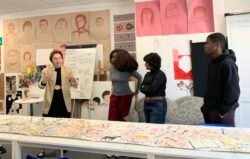
Speakers, remarkable mentors… Brian Cox! We, the adults, barely talk about it — and it is the students themselves who point it out. They say: “Why do you keep quiet about this? It is an extraordinary opportunity! What school could give us that?”
And I would sign my name to that.
Brian Cox is a very well-known name.
He is a celebrity in physics, in astrophysics. He talks about the universe in such accessible language that the whole of the West adores him.
But it is not about one name. Because Mr Clarke is chairman of the ATOM Festival of Science & Technology, our students find themselves in a circle an ordinary school cannot enter. Frank Close, the Oxford physicist and one of the festival’s founders — one of our students was given a signed copy of his book. Jocelyn Bell Burnell, the woman who discovered pulsars. Robin Ince from Radio 4. Every year: quantum computing, neuroscience, astrophysics, and all of it first hand.
And these speakers are also accessible to the students. When Brian Cox came, the students were so energised that they decided to make their own podcast inspired by his lecture — about the Fermi paradox. And one of them spoke to him afterwards about his own discovery, and came away with his direct contact. Try finding that opportunity anywhere else!

You mentioned that education has to connect with practice. Are the bootcamps about the same thing?
Exactly that. Last year we ran our Innovation, Technology & Entrepreneurship Bootcamp for the first time — a five-day programme at Keble College, University of Oxford, together with UC Berkeley SCET. And do you know what was most interesting about it? It was not a closed course for our own students. Participants came from all over the world — school pupils, undergraduates, doctoral researchers, working professionals. One participant said afterwards that it felt as though everyone was on the same level — undergraduates, PhDs, professionals — all learning and growing together.
The programme was led by Gigi Wang, Industry Fellow and faculty member at UC Berkeley SCET and Chair Emeritus of VLAB — someone who has advised hundreds of start-ups around the world. Five days: entrepreneurial culture and vision, leadership and understanding the customer, business models, finance and fundraising — and, at the end, a pitch to a jury of investors and experts.
For a seventeen-year-old, that turns the world upside down. They suddenly see that an idea can become something real, that they are being taken seriously, that the people sitting beside them are ten years older — and they are their equal. That is precisely the connection between theory and practice we were talking about.
This year Silicon Valley returns to Oxford: the bootcamp is at Keble College again, and it is open to local and international participants alike — not only to Cherwell students. Residents arrive on the Sunday and leave on the Friday, after the final presentations. We are accepting applications now.
“We take a young person — and through precision work, a jeweller’s work, we help him become someone capable of making his own way. That is our result.”
Find out more
To discuss which programme is right for your child, our Admissions Team will be glad to talk it through.
Telephone: +44 (0) 1865 242670 · Email: secretary@cherwell-college.co.uk
Register your interest · Retake courses · Contact us
| READ NEXT
Results Day 2026: What Your Options Really Are A calm, practical guide for students and parents — what happens on the day, what each outcome actually means, and what to do next. |